Dashboard
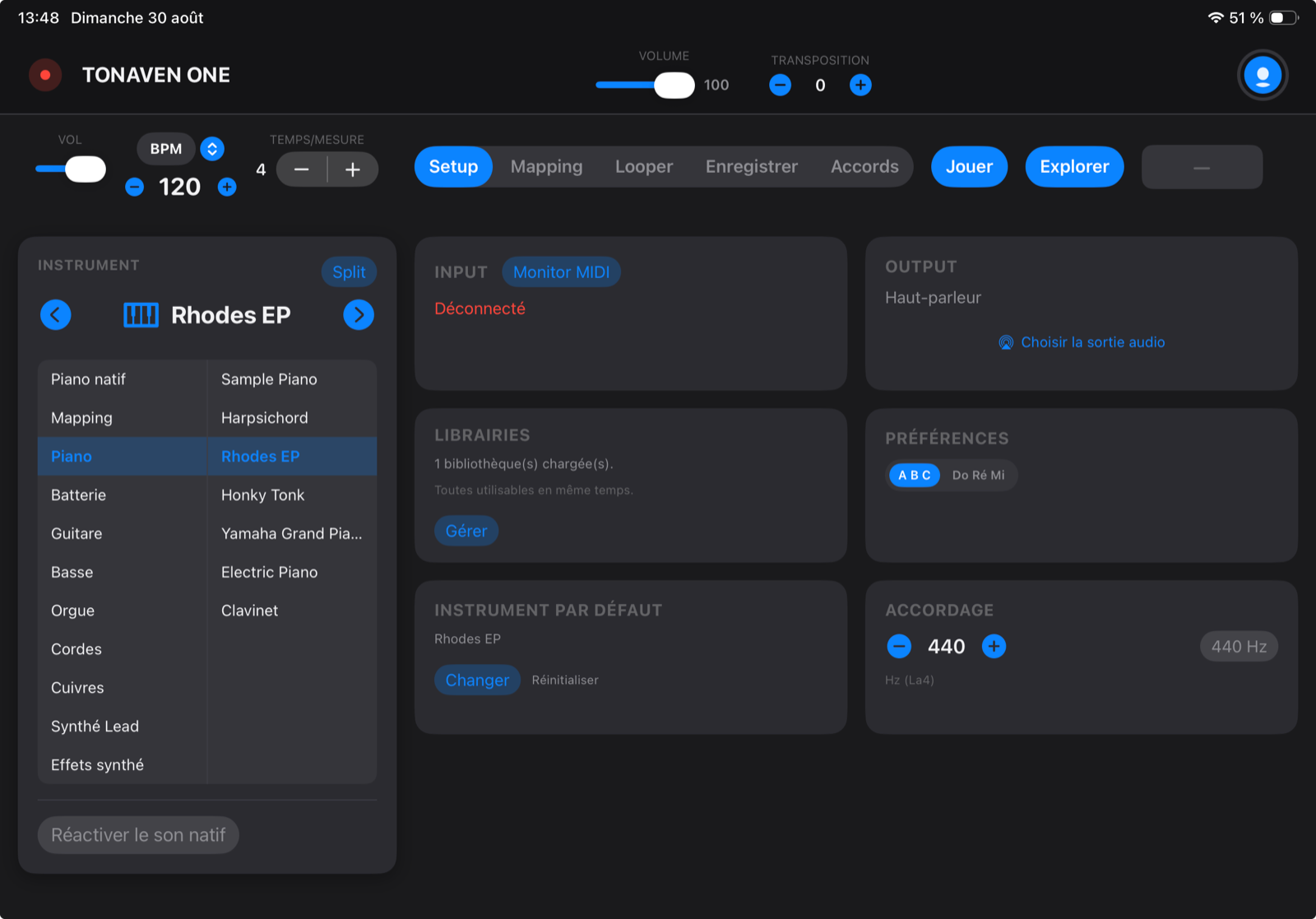
Every setting on one screen
No key combinations to memorise, no manual to dig out. Everything is shown, everything is a fingertip away — and it's all still there when you switch back on.
Click a setting to find it on the screen.
Tonaven One
See what it does
Every setting on one screen
No key combinations to memorise, no manual to dig out. Everything is shown, everything is a fingertip away — and it's all still there when you switch back on.
Click a setting to find it on the screen.
Create, record, keep everything
The looper, the sequencer and the recorder are on the screen, on at the same time as the piano. Nothing to launch, no computer in the chain — and everything comes back out as MIDI, into whichever software you like.
Record a loop, add another on top, as many as you like. Delete the ones you don't like and start again. Trying things has never been this easy.
Add real drum grooves to your loops, simply.
In two taps you can record everything you create, and find it again just as easily.
No computer needed to record anything, ever.
Your pieces and your loops leave as MIDI, into the software of your choice.
The mobile app is included with every Tonaven One. Your pieces, your chords and your loops move from the screen to your phone in one tap.
Nothing you play leaves for a server. The transfer happens directly between the screen and your phone, over WiFi on your local network. No account to create, no subscription.
From your first note to the circle of fifths
A real programme, not a handful of exercises. Every step opens with an explanation — like a teacher speaking before letting you play — then the device checks what you play, note by note.
A guided journey through thirteen tiers, from beginner to expert. Each tier mixes pieces, a technique exercise and two mini-games.
Sixteen theory subjects in the programme, each across four levels, played at the keyboard rather than read in a book. Six are already in the device, the rest are on their way.
The song bank plays two ways, and twelve technique exercises generate themselves. What you do gets counted.
Manufacturers say so themselves: most of the options can only be reached through long button sequences.
The exact sequence from the manual. Click in order — one mistake and you start again.
It's visible at all times. You move it, and you're done.
Casio goes as far as publishing a "Keyboard Function List": a three-page document whose entire content is the map of its own keyboard's button combinations.
This is the model that goes to the printer, accurate to a tenth of a millimetre. Turn it around, look at it from every angle.
The bracket passes under the piano, the clamping arm over the top, a single M8 screw does the rest. Full mount details
A word of honesty, because this is the question that decides whether Tonaven is any use to you.
Tonaven speaks the standard language of keyboards. If your piano has a USB socket, it can be driven — Roland, Yamaha, Casio, Kawai, Korg, including models the manufacturer stopped supporting long ago.
Sending sound back out through the piano's own speakers over the same USB cable only works on some models. We're testing them one by one and the list will be published here, with no rounding of corners. On the others, an ordinary audio cable does the job.
Test my piano nowTonaven isn't on sale yet. We're building the compatibility list from the pianos people actually own — your answer decides what we test first.
You'll get one message when the compatibility list goes up, and one at launch. Nothing else.
We'll come back to you when the compatibility list is ready.
No. Everything is on the screen: settings, playing, creating, recording. No computer in the chain, nothing to launch before you start.
Two mounts are included: a stand for flat surfaces, and a mount that clamps the unit onto the body of the piano. It becomes part of the instrument, always there — and it comes off in one gesture, without tools.
It matters, and you can check before buying. Not every manufacturer got this right, so we built a tester: plug your piano into your computer and it answers in a minute. Test my piano now
Most likely, and that is one of the reasons this project exists. Manufacturers' apps ignore older models and never speak to another brand. Tonaven uses the standard language every keyboard has shared since the 1980s.
All of them. Your settings and preferences come back exactly as you left them every time you switch on. That is one of the reasons the product exists: play straight away, without redoing key combinations you end up forgetting.
Yes. Buying the Tonaven One gives you the software on three devices of your choosing — phone, tablet, computer. It can also be bought on its own, if you would rather run it on hardware you already have.
Everything exports as MIDI, an open format any music software can read. And everything moves between your devices on its own: record at the piano, export from your phone, whenever and wherever you like.
No. You buy the Tonaven One and it is yours — with a software licence for life. Everything was designed so a subscription would never be needed: these days we own very little, and we pay to keep it. Not here.
The Tonaven One and its software are €178 at launch, for the first units — €210 afterwards. The software on its own is €99, €119 afterwards. Shipping within France and the European Union.
The prototype already works: screen, touch, connection to the piano, sounds, loops, learning. What is left before sale is manufacturing. We will not give a date until it is one we can hold, and people on the list will hear first.
It is used to write to you about Tonaven, and nothing else. It is stored within the European Union, never sold or passed on, and every message carries an unsubscribe link. You can ask for it to be deleted at any time.